Introduction
Discover Zeta, a Windows-first Godot .NET desktop prototype for managing synthetic digital inventory and orders with encrypted local persistence.
Manage a synthetic warehouse
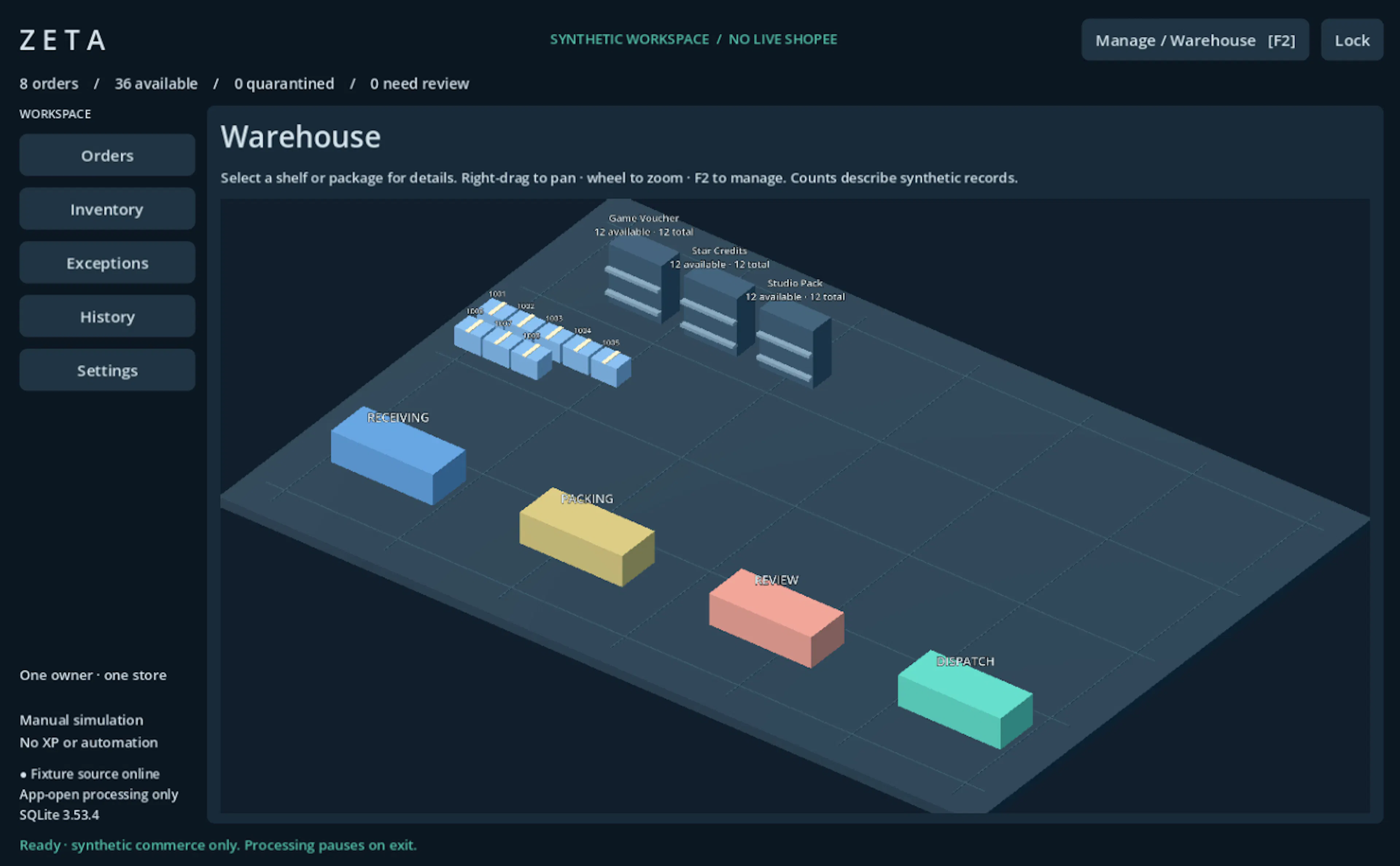
Use Zeta to manage synthetic inventory, simulate order fulfillment workflows, and visualize committed warehouse state through conventional management screens or an optional 3D view. The prototype combines local persistence, deterministic command handling, recovery tooling, and synthetic marketplace and delivery adapters in one Windows desktop application.
What is Zeta?
Zeta is a Windows-first Godot .NET desktop prototype for managing synthetic digital inventory and synthetic orders. It supports product and inventory management, exact item-to-product mappings, order reservation, simulated delivery, exception handling, audit history, and encrypted same-user snapshots.
Zeta is not a live Shopee integration or a production fulfillment system. Its marketplace and delivery effects are represented by in-memory synthetic adapters, so the application can demonstrate order and recovery behavior without contacting external services or handling real customer data.
The synthetic boundary
Every value that represents marketplace or fulfillment data must remain synthetic. The application requires the DEMO- prefix for:
- Imported inventory codes.
- Products.
- Item and model identifiers.
- Recipients.
- Order IDs.
- Fixture evidence and seller-attestation references.
Zeta enforces this boundary across imports, order workflows, evidence, persistence, and test fixtures. Do not enter real credentials, customer information, delivery codes, or marketplace identifiers.
Zeta does not connect to Shopee or any other live marketplace. Treat every record, code, recipient, order, and evidence reference as synthetic, and use the DEMO- prefix wherever the application requires it.
What Zeta is not
The prototype deliberately excludes capabilities that would require production integrations, identity controls, or operational safeguards:
- Live Shopee calls or other live marketplace integrations.
- Real customer or seller credentials.
- Real delivery or automatic fulfillment.
- XP, rewards, or gamification.
- Portable or lost-device recovery.
- Production authentication.
- Production deployment signing.
These exclusions define the prototype boundary. Synthetic delivery outcomes can be confirmed, rejected, pending, partial, unknown, or marked as a simulated crash after effect, but they never represent a real provider response.
Architecture overview
Zeta uses a layered architecture that keeps domain behavior independent from Godot, EF Core, and SQLite.
Godot UI
    ↓
CommerceService
    ↓
Core interfaces and domain models
    ↓
EF Core DataSession
    ↓
SQLite
External effects cross explicit ports and adapters:
CommerceService
    ├── IMarketplaceAdapter → SyntheticMarketplace
    └── IDeliveryAdapter    → SyntheticDelivery
Zeta.Core contains the pure C# domain model, state transitions, ports, and application service. Zeta.Infrastructure provides EF Core persistence, SQLite coordination, encryption, and synthetic adapters. Zeta.Godot renders the desktop interface and warehouse visualization. Tests use temporary SQLite databases with ephemeral encryption keys to validate persistence and workflow invariants.
Key capabilities
Synthetic inventory management
Create products, import synthetic codes, track stock states, configure exact mappings, and identify low-stock products.
Order lifecycle simulation
Observe synthetic orders, reserve complete order lines atomically, approve delivery, simulate outcomes, and manage exceptions.
3D warehouse visualization
Inspect committed inventory and order projections in an optional orthographic warehouse view without changing business state.
Encrypted local persistence
Store inventory and operational data in encrypted local SQLite storage protected by Windows user-scoped key material.
Conservative recovery
Detect interrupted delivery attempts, quarantine potentially exposed units, and move uncertain orders to review instead of retrying automatically.
Audit trail
Record business actions, delivery evidence, command results, and recovery decisions in protected audit history.
Explore the project
Run the prototype
Start the Windows desktop application and review the seeded synthetic products, stock, and orders.
Follow a synthetic order
Refresh an order, reserve its mapped inventory, approve delivery, and choose a simulated outcome. The application keeps uncertain outcomes available for review.
Inspect the architecture
Trace commands from the Godot interface through CommerceService, the core ports, EF Core persistence, and the SQLite store.